IBU (International Bitterness Units) is a lab measurement of hop-derived bitter compounds in beer, roughly the milligrams per liter of iso-alpha acids extracted from hops during the boil. It’s a real chemistry number, not a marketing gimmick, but it’s not a bitterness guarantee either. Two beers can share the same IBU and taste completely different depending on malt sweetness, roast, and alcohol. Use the number as one clue among several, not the whole verdict, when you’re deciding what to pour next.
TL;DR:
- Beers with an IBU over 110 cannot physically dissolve more bitterness in solution, making claims of 200 or 300 IBU mostly marketing hype.
- Dry hopping and hop aging can add perceived bitterness without significantly increasing measured IBU, leading to taste differences from the label.
- IBU measurement variability means that values can differ by up to 10% even in certified labs, especially at high bitterness levels.
- Style and malt characteristics heavily influence perceived bitterness, so beers at the same IBU can taste very different depending on ingredients and processing.
- Predictive formulas estimate IBU pre-brew but do not account for post-boil changes, so actual bitterness can vary from the forecast.
Table of Contents
- Beer Bitterness Scale Basics: What IBU Measures and the Chemistry Behind It
- How IBU Gets Measured in a Real Lab
- IBU Ranges by Beer Style: A Quick Reference
- Why Your Beer Doesn’t Always Taste as Bitter as Its IBU Suggests
- How Brewers Estimate IBUs Before the Beer Even Exists
- Reading a Beer Bitterness Scale on a Menu: Practical Rules
- How We Think About Bitterness on Our Self-Pour Wall
- Taste the Bitterness Scale for Yourself at Space Brewpub
- Sources
- FAQ
Beer Bitterness Scale Basics: What IBU Measures and the Chemistry Behind It
Hops start out mostly flavorless in their raw form. Alpha acids, the resinous compounds inside hop cones, don’t taste bitter at all until they’re boiled. Heat converts them into iso-alpha acids through a process called isomerization, and it’s these isomerized compounds that your tongue reads as bitterness. The longer and harder you boil hops, the more alpha acids convert, which is why a 60-minute bittering addition hits differently than a 5-minute flame-out toss.
Here’s where it gets messy. Hops don’t stay chemically stable once they’ve been boiled, or even before they hit the kettle. Oxidized hop compounds called humulinones form as hops age, and they contribute their own bitterness that older lab methods struggle to separate from iso-alpha acids. That’s part of why a dry-hopped IPA can taste rounder or sharper than its printed IBU suggests.
A few things worth knowing about the number itself:
- One IBU roughly equals 1 milligram per liter of iso-alpha acids in the finished beer.
- The scale traces back to a mid-20th-century correction factor (sometimes cited as the 5/7 rule) that early brewing chemists used to standardize readings across labs.
- The European Brewery Convention harmonized its EBC bitterness scale with the American IBU system decades ago, though small numeric gaps between EBU and IBU readings still show up depending on method.
How IBU Gets Measured in a Real Lab
Brewers don’t guess at IBU. They test for it, usually with a method that’s been standard since the 1960s.
The spectrophotometric BU method, codified as ASBC Beer 23, breaks down into four basic steps:
- Acidify a beer sample to stop further chemical reactions and free up the bittering compounds.
- Extract those compounds into isooctane, a solvent that pulls the bitter acids out of solution.
- Measure the extract’s absorbance at a wavelength of 275 nanometers using a spectrophotometer.
- Multiply that absorbance reading by 50 to get the final bitterness unit value.
HPLC (high-performance liquid chromatography) offers a more detailed alternative, separating individual bittering compounds instead of lumping them into one absorbance reading. It’s more precise for research purposes, but it requires equipment most breweries, and virtually all brewpubs, don’t have on hand, so the spectrophotometric method remains the industry default.
Pro Tip: If you see a beer marketed at 300+ IBU, treat it as a novelty claim rather than a lab fact. Measurement accuracy degrades well before you get anywhere near that range.
That degradation isn’t hypothetical. Repeatability testing on the BU method shows coefficients of variation running from roughly 1.5% to 10% depending on the bitterness range tested, meaning even a certified lab can return slightly different numbers on the same beer. Extreme high-IBU marketing claims tend to outrun what the method can reliably confirm.
IBU Ranges by Beer Style: A Quick Reference
Bitterness bands map fairly predictably to style categories, though there’s plenty of overlap at the edges.
- Low (0 to 20 IBU): light lagers, many wheat beers, cream ales. This is where malt sweetness dominates and hops play a supporting role.
- Moderate (20 to 40 IBU): amber lagers, English-style pale ales, brown ales. Bitterness is present but balanced against caramel and toasty malt notes.
- High (40 to 70 IBU): American IPAs, many stouts, and imperial pale ales. Hop character starts driving the flavor profile here.
- Very high (70 to 100+ IBU): double IPAs, barleywines, some imperial stouts, where hop bitterness is the headline feature rather than a supporting note.
Your palate has real limits, though. Most people can detect bitterness starting around 4 to 9 IBU, so even a “low bitterness” beer registers as clearly bitter to your tongue. On the other end, iso-alpha acids reach a theoretical saturation point near 110 IBUs. Beyond that, the compounds don’t fully dissolve into the beer, so claims of 200 or 300 IBU are describing a number that can’t really exist in solution, not a beer that’s meaningfully more bitter than a well-made double IPA.
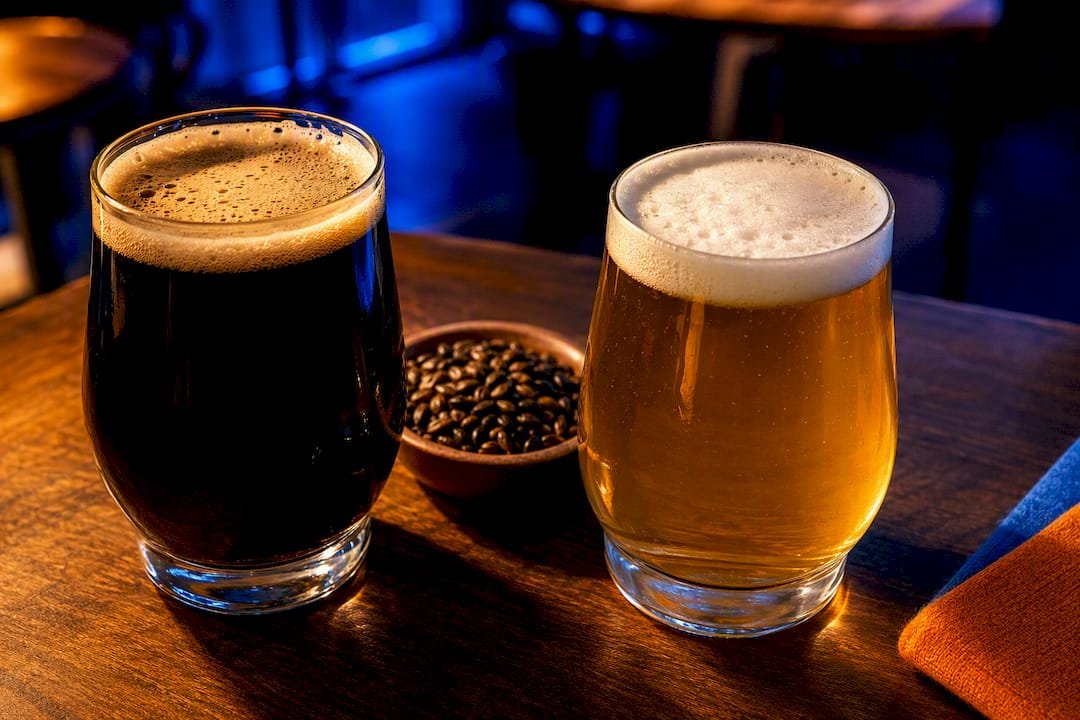
Style still tells you more than the raw number. A 40 IBU stout and a 40 IBU pale ale can taste worlds apart because roasted malt reads as bitter on its own, stacking with hop bitterness rather than canceling it out.
Why Your Beer Doesn’t Always Taste as Bitter as Its IBU Suggests
IBU measures a chemical fact. Perceived bitterness is a sensory experience shaped by everything else in the glass, and the gap between the two trips up a lot of drinkers.
- Malt sweetness softens bitterness. A 60 IBU barleywine can taste less sharp than a 40 IBU pale ale because residual sugars mask the hop bite.
- Roast character in stouts and porters reads as its own kind of bitter, stacking on top of measured IBU rather than replacing it.
- Alcohol and body change texture. Higher ABV beers often feel fuller and rounder, which can dull the edge of hop bitterness even when the IBU count is high.
- Carbonation and water profile shift how bitterness lands on your tongue. Higher carbonation tends to sharpen the perception; soft water can smooth it out.
- Dry hopping loads up aroma and flavor compounds without proportionally raising the measured IBU, since most dry-hop additions happen after fermentation when isomerization has mostly stopped.
- Aged or oxidized hops contribute humulinones, adding a bitterness that older BU methods don’t cleanly separate from iso-alpha acids.
Pro Tip: If a menu lists two beers at the same IBU, check the style and ABV before assuming they’ll taste alike. A 55 IBU imperial stout and a 55 IBU West Coast IPA are built from completely different flavor architecture.
How Brewers Estimate IBUs Before the Beer Even Exists
Recipe formulation happens well before a beer ever sees a spectrophotometer. Brewers rely on predictive math to estimate what a finished beer’s IBU will land at, and three formulas dominate that conversation.
- Tinseth is the most widely used model, treating hop utilization as a continuous curve across the entire boil rather than a fixed rate.
- Rager tends to run hotter, often predicting higher IBU values than Tinseth for the same hop bill, especially in high-gravity worts.
- Garetz factors in elevation and other brewhouse-specific variables, making it a favorite among brewers dealing with unusual water chemistry or altitude.
None of these formulas account for what happens after the boil. Fermentation, dry hopping, filtration, and even yeast strain can shift the finished beer’s actual IBU away from the calculated target. That’s why homebrewers should treat formula output as a planning number, not a guarantee, and taste small test batches before scaling up a recipe that’s chasing a specific bitterness target.
Reading a Beer Bitterness Scale on a Menu: Practical Rules
Knowing the chemistry is one thing. Using it at a bar or in front of a fridge full of cans is another. A few rules make the number actually useful:
- Check IBU alongside ABV and style before ordering. A 65 IBU imperial stout and a 65 IBU session IPA will drink nothing alike.
- Ask for a sample pour if you’re unsure. Most taprooms will let you taste before committing to a full glass.
- If sharp bitterness isn’t your thing, stick to beers under 20 IBU in malt-forward styles like brown ales or honey beer.
- If you want hop bite, look for IPAs or double IPAs sitting at 40 IBU or higher, paired with dry-hop notes on the description.
- Let server recommendations fill the gap between the printed number and what actually hits your palate. Staff who pour beer daily know how a given batch is drinking that week, which a static IBU number can’t capture.
How We Think About Bitterness on Our Self-Pour Wall
We stock our beer wall across the full bitterness spectrum on purpose, from crisp low-IBU lagers to hop-forward IPAs and a dry stout that proves roast can carry as much bitterness as hops. Self-pour taps mean you’re not locked into a full pint before you know if something’s too sharp. Pour a small sample of a 15 IBU wheat beer, then one at 60, and you’ll feel the difference the article just walked through instead of just reading about it.
— Manu
Taste the Bitterness Scale for Yourself at Space Brewpub
Reading about IBU only gets you so far. The fastest way to actually understand how bitterness works is to pour a few ounces side by side and taste the gap between the number and the flavor. That’s exactly what our self-pour beer wall is built for: no bartender waits, no full-pint commitment, just small pours across our tap list so you can compare a light lager against a hop-heavy IPA in the same sitting.
Pair your tasting flight with food that plays well against bitterness. A Tikka Masala or a Stewed Chicken can round out a hoppier pour, while lighter bites like Vegetable Samosa or a Med Veg Bowl sit nicely alongside crisper, lower-IBU beers. Browse the full menu for more pairings, and when you’re ready to build your own bitterness tasting flight, reserve your table and come pour a few samples yourself.
FAQ
What is the typical bitterness level of beer?
Most commercial beers fall somewhere between 10 and 50 IBU, with light lagers near the bottom and pale ales and IPAs pushing toward the higher end. Style is the biggest driver: a wheat beer and a double IPA can differ by a large margin.
Is 20 IBU high?
No, 20 IBU sits at the low to moderate end of the scale, roughly where amber lagers and mild pale ales land. It’s noticeably bitter compared to a light lager but mild next to an IPA that often starts around 40 IBU and climbs from there.
What is the 3:30:300 rule for beer?
There’s no established brewing-science standard by that name, so treat any claim built around it with caution. If you’ve seen it referenced as a beer rule, it isn’t tied to the IBU scale or any recognized measurement method covered here.
Which beer is the most bitter?
Double IPAs and barleywines typically post the highest IBU numbers, often in the 70 to 100+ range, though iso-alpha acids reach a saturation point near 110 IBU, so claims well beyond that describe a beer that can’t chemically hold that much dissolved bitterness. Roast-heavy stouts can taste just as bitter at lower measured IBU because roasted malt adds its own bitter character.